Kevin DuBrow
(Quiet Riot)
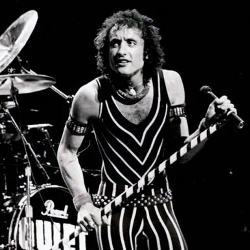


When Heavy Metal icons Quiet Riot unleashed their third full-length offering Metal Health (1983), few couldve anticipated the impact it’s release would ultimately have on the genre as a whole. Led by frontman extraordinaire Kevin DuBrow, the group became a veritable staple of the fabled MTV and Sunset Strip scene. Love him or loathe him, he was an irreplaceable talent who left us far too soon in 2007 at the age of fifty-two. Please join us as we revisit our 2004 conversation with DuBrow in support of what would ultimately become his lone solo offering, the Blues-soaked collection of covers titled In For The Kill. As incendiary and outspoken as ever, DuBrow was kind enough to discuss, among so many other things, his feelings regarding his former band-mates, the Quiet Riot recordings he genuinely regrets (!) as well as the many highs and lows of his multi-Platinum past.
Todd: For the uninitiated, how was Quiet Riot initially formed? While the group’s association with (future Ozzy Osbourne guitarist) Randy Rhoads has been documented ad nauseam, how did you actually become acquainted?
Kevin: “It was all Randy’s doing, really. I got a call from him in March of 1975. I had just come home from a canceled Humble Pie concert. My brother had scribbled down a message that said ‘Smokey’s ex-guitar player wants to know if are interested in singing in his band’. Smoky was this gay singer in Hollywood that everyone used to roll their eyes about. They used to play his single at Rodney Bingenheimer’s English Disco. He was a friend to the stars in the ’70’s. Randy wasn’t on that particular single, but I remember hearing it and it was just awful. Randy and (original Quiet Riot bassist Kelly Garner) came to my Mom’s house. There are home movies of me singing. Later on in the week, I was actually playing with Stan Lee, the guitarist from The Dickies and I drove out to Randy’s Mom’s house in Burbank. …(He had) a little practice amp and this Gibson SG. He plugged in and the first thing he played was the riff that later became (the Ozzy Osbourne classic) “Suicide Solution”. We called it “Force Of Habit”. He turned out to be a combination of all of my favorite guitarists. He played a bit like (late David Bowie sideman) Mick Ronson, a little bit like Jeff Beck, a little bit like Ritchie Blackmore, and a little like (late Blues guitar legend) Johnny Winter. It was just fucking unbelievable. I remember it all like it was yesterday. He was so great and was absolutely unaware of how amazing he was sitting in this little Burbank bedroom. From that point on, we formed Quiet Riot. We knew from that moment that he was destined for greatness. There were no two ways about it. I’d seen guys at (famed club) Whiskey A Go Go on a national level that couldn’t touch him. My theory was that if this guy that was this great that no one had ever heard of him, how many other guys were there like that out there? I think it was fate. Or, they were desperate for a singer because nobody had the balls to sing in a band like that in those days. I’ve never had too many fears of rejection (laughs).”
Todd: Musically, what are your influences? The cover of “Itchycoo Park” from Terrified (1993) made it clear that (Humble Pie and Small Faces co-founder) Steve Marriott had a significant impact on your delivery and style.
Kevin: “There are vocal influences, songwriting influences and so many different things. As a songwriter, (The Who guitarist/vocalist) Pete Townsend is my biggest influence along with Ian Hunter from Mott The Hoople and The Beatles. As a singer, Steve Marriott from Humble Pie is still my all-time influence. (Bad Company and Free vocalist) Paul Rogers, (The Who frontman) Roger Daltry and (former Deep Purple and Trapeze vocalist) Glenn Hughes to a certain extent, but I can’t do anything he does. I think he influences me more as a musician than he does as a singer because we come from two different places vocally. He comes from a place that I don’t think anyone else on the planet can find (laughs). It’s so great and so hard to duplicate. Those are pretty much my influences. For me, it’s his solo work that kills me. He has a body of solo work that is just amazing. I thought he was great with Deep Purple, too. If I had been (former Deep Purple and future Whitesnake frontman) David Coverdale, my penis would have crawled up my asshole and disappeared. As much as I like David as a singer and as a person, there is only one Glenn. Singing against that is not something I would want to make a habit out of. I did it once last year. Glenn invited me to come sing at a celebrity golf tournament for missing children. Glenn came out on stage and played bass on “Metal Health” and half way through it, we played (the Junior Wells classic) “Messin’ With The Kid”. …It’s just not something you’d want to put yourself up against regularly at all.”
Todd: What was the main motivation behind releasing your solo album In For The Kill? Why release it all now?
Kevin: “It’s an idea that Frankie Banali and I had discussed many years ago and were supposed to do together. Quiet Riot had just broken up. (Shrapnel Records founder) Mike Varney called me up and asked me about Quiet Riot doing it. That was his initial idea. Being that Quiet Riot had just broken up, I suggested to Frankie that we do it without all being in the same room. That was the only way it was going to happen. Some of the songs on In For The Kill Frankie and I had picked out over ten years ago, but would not have been executed properly with the last Quiet Riot line-up. That line-up was very limited in its scope. It played certain things alright, and other things it couldn’t play. Varney called me a week later and asked me if I wanted to do a solo album. I told him I wanted to do a solo album of originals with Glenn Hughes Producing. That was always my original plan. He told me he wasn’t interested in doing an album of originals, but if I wanted to do a covers album, we could talk. And we ended up working out a deal that very night and were recording within the next week. It was real fast.”
Todd: What musicians did you work with on In For The Kill? What, if any, input did you have regarding who you worked with? I would imagine not being entirely clear on whom you’d be working with was nerve-wracking.
Kevin: “Mike Varney pretty much assembled the players. He had this guy Kevin Curry on guitar. I was really concerned about him because those songs are sacred to me. It’s my bible, what I grew up with, especially the Humble Pie Song “Red Light Mamma”. But when I heard what he was capable of, I was just amazed. The bass player was already gotten because he owned the studio and by using him, we got free studio time. He a nice guy, but he’s no Chuck Wright, ya know? Mike Varney had a different drummer in mind who I didn’t think was right for the project. …That was the only input I had on the musicians, so we got Jeff Martin (Badlands, Racer-X) and he was great. We needed somebody in a hurry and there was nobody in Las Vegas that we could find. Jeff drove down from Lake Tahoe and turned out to be a great guy. I ended up doing some summer dates with him. Michael Lardie, who has turned out to be one of my best friends was actually someone who I had done multiple shows with when he was in Great White yet had never said anything more than ‘hello’ to in fifteen years of touring. Carlos Cavazo said he didn’t like Michael, which is weird because nobody dislikes Michael Lardie. He’s one of the nicest guys in the world. Plus, Carlos Cavazo doesn’t dislike anybody, so I don’t know what the problem was. Because of this, I was always a little hesitant to talk to him. He turned out to a great collaborator. He made my vocals sound great. He made the whole thing fun to do. It’s fun when there is no pressure and no egos, ya know?”
Todd: In hindsight, how do you view the results of the Metal Health era line-up reunion? As a life-long fan of the group, when the reunion was officially unveiled, it felt as if portions of my childhood had somehow returned.
Kevin: “It was a nightmare for me. …You have to remember that when we went in to record Metal Health, the line-up was me, Frankie, Carlos and (bassist) Chuck (Wright). Carlos had just gotten the gig a month before. The guys that we had auditioned with was me, Frankie, a guy named Craig Turner and Chuck. Right before that, it was me, Frankie, a guy named Bob Stephen and Chuck. It wasn’t a band at the time. It was called DuBrow. If you go look at the tape box in Sony’s vaults, it says ‘DuBrow’ on them. We changed the name later. The Metal Health line-up, in my opinion, is something people envisioned as a band because of its use in videos and because people associate it with a certain time in their lives. Musically, the crux of it was something Frankie and I had been doing in clubs for a few years with a revolving door of other guys. That was the line-up that we had right as we signed the deal. I wouldn’t say that line-up was particularly responsible for the architecture of that sound. They just happened to be in the band when we got signed. It was also a line-up that had it’s inherit problems. The problems of the ’80’s were made worse by my drug abuse and by my ego. I’ve blabbed on and on about what they were and I really don’t like to put a spotlight on a problem that isn’t there anymore, ya know? Musically, I felt the life had been sucked out of the band by the end of 2003. It was a negative situation. When I’m not into something, I can be pretty difficult. I can be pretty territorial about my music. I take it very serious when I am up on stage. If the band isn’t together as a unit and isn’t grooving musically, I get very miserable. Every part of my life is miserable because I love music so much. Just because we may not be considered a valid musical force doesn’t mean that I don’t take it as seriously now at the age of fifty as I ever did when I was eighteen, ya know?”
Todd: Musically speaking, how do you feel the group’s current line-up compares to the fabled era? While it’s clear they’re able to replicate the ‘tonalities of yore’, how do they compare as personalities amid the group itself?
Kevin: “Musically, it smokes it smokes it down the road. It buries it on every fucking level. In the past, there were personality conflicts. Certain people just aren’t meant to play together. If you could see how a certain person’s actual personality differs from what the public perceives them to be, you’d be amazed. I can tell you that right now, we are already writing for our next studio record. We already have more than enough material even though we haven’t started recording yet. By the time we get it done, it’s going to be the best record that we’ve ever done. Frankie just played me a demo of three songs that he’s done with a guy name Neil Citron at Steve Vai’s studios. I’ve been doing my demos up here with (Great White alumni) Michael Lardie and (current Quiet Riot guitarist) Alex Grossi. It’s funky, it’s heavy and some of it sounds more contemporary, while some of it sounds super ’70’s retro. Live, we have a band that plays in the groove, in the pocket and the tempos are great. It’s got a swing. You can play as loud as you want on stage if you play the parts that are right for the tunes. There is no limit to the volume, it doesn’t hurt your ears. But when it’s all shit, it’s all a little hard to take. We did a New Years Eve show in Baltimore and I was a bit concerned because we’d only had one rehearsal, but we sounded fucking amazing. The Metal Health era line-up never rehearsed. We never rehearsed because there was no fucking point. Nobody listened. I told Frankie when we got back together that we had to have a different philosophy we had to rehearse. You want to have an element of spontaneity each night, but you also want each member to know the songs going in. One of our previous members could not remember how to play “Slick Black Cadillac” at the beginning of a weekend run. That’s a song we’ve been playing since 1977. I don’t know what to say about that. The rehearsal was great and the shows have been great. We’re doing “Condition Critical” again and the song sounds much better than the record. Alex listened to the original recording and duplicated what Carlos had done live. Carlos never had that sound live. Alex is serious about his tone. He brings these new elements to the band.”
Todd: Were you surprised Carlos opted to not re-join the group once it officially re-united? I was a bit surprised.
Kevin: “Not really. Carlos is a nice guy and a really good guitar player, but he’s also, without a doubt, one of the laziest people to ever walk the planet. He’d have a hard time arguing with me if he were sitting right here. The guy sleeps all day. He hasn’t written a song in five years. He’s probably writing songs with whatever band he’s with now because he has to figure out a way to pay his rent. He never called anybody when we weren’t working. There was no communication. I like Carlos, but you’re only as strong as your weakest link and Carlos just didn’t care. Alex cares. I talk to him three times a day. He was up here in Las Vegas and we wrote forty songs for the new album and they’re all just smokin’. I’ve already nailed one of the vocals. I have some great recording software on my computer. I have nothing against Carlos and I know the gap left by his absence will give a lot of people the wrong perception about us because we don’t have that many original members, but neither does Dokken or other bands that go out. We sound more like Quiet Riot than we did with the reunited Metal Health line–up.”
Todd: I’ve been able to see the group live twice. The first time was in a small club and my ears rang for two days after the show, but when I saw The Glam Slam Metal Jam tour, it was much, much quieter. Why play ‘so loud’?
Kevin: “I’ll tell you right now that the whole volume problem was related directly to (bassist) Rudy Sarzo. He insisted on playing at a certain level and everyone had to turn up to be heard over it. He would not turn down. He denies it in every interview that he does, but in my defense, if you ask any sound guy that has ever Mixed a Quiet Riot show, he’ll tell you the problem is with the bass. …As I say, with that version of the band, playing clubs was more miss that hit. The Glam Slam tour was a better tour for us because we couldn’t hear how loud we were playing and we were just glad to be playing in bigger places and playing to more people. It was just a false sense of what was going on, though. It was a good show and we performed very well. Like I’ve said before, Rudy Sarzo is a very good performer, but you don’t hear with your eyes. If you had recorded some of the shows, which we did, you’d hear that they were absolute garbage. Total garbage. Words can’t describe. People have a preconceived perception of what they are going to hear. When a band has a lot of pyro and special effects onstage, people tend to walk away saying what a great show it was, but when the band records themselves, they have to doctor the tapes, so their playing isn’t what you think. …It’s about what you see and not about what you hear.”
Todd: What type of set list will you be working with? Will you be attempting to add material from In For The Kill to the Quiet Riot repertoire? I feel that would make for a nice change of pace, mostly for the ‘die-hard’ fans.
Kevin: “We’re gonna do “Red Light Mamma, Red Hot”. We’re already been doing it, in fact. It turns into a showcase for everybody. We do it long and we do a bunch of songs in the center of it. We do some Cream and some more Humble Pie. Alex gets to play some great Blues guitar and the rhythm section just grooves. I just stop signing and let them go. They get my dick hard they’re so good. …Chuck Wright is just so amazing. We’re lucky he wasn’t busy. …We’re pretty much going to ignore the Guilty Pleasures era. We’ve been playing stuff off of that one for a long time. It’s hard for me to talk positively about the new line-up without slagging the old line-up, but I can only explain by comparison. The last line-up, as I’ve said before, had a great deal of difficulty rehearsing and learning anything new. Nobody would have anything learned. We had the same set list for the last three years. And because of that, we’re not going to be doing anything from Guilty Pleasures. We’re doing stuff we haven’t been or couldn’t do last summer. We’re doing “Condition Critical” again and we did “Breathless” this year on New Year’s Eve for the first time in twenty-three years and it sounded great. We’re also doing “Put Up Or Shut Up” from QR III We’ve learned a lot of additional material like “The Ritual” from Alive And Well because I’m now able to call out a song and we can just do it. That is something that wasn’t impossible with the last line-up.”
Todd: Will there be new opportunities for obscure and/or infrequently played material? Those rarities are so fun.
Kevin: “Chuck has been playing his “Bass Case” solo, we’ve been doing “The Wild And The Young” (both from QRIII). I just love going to see bands that are able to play a song when a fan shouts it out. I haven’t seen that happen in twenty years. In the ’70’s, I used to see bands like Humble Pie. If you’d scream out a song, they’d play it. That’s a real band, man. If you’d have done that with the Metal Health era line-up, Carlos would have looked at me and just shook his head. Now, we’re able to remember all of our material. When someone yells out “Cum On Feel The Noise”, it’s not like we’re not gonna play it, but now, if somebody yells out something like “Breathless”, bam, were gonna play it, ya know? It’s a matter of the people in the band applying themselves and learning a larger repertoire of material and keeping it fresh. …And that’s exactly what has happened with this line-up here.”
Todd: Looking back, what were the group’s motivations behind firing you from the group? That always felt odd.
Kevin: “I wanted to fire the management and leave the record label. I was very adamant about doing so. The rest of the band was too chickenshit to do it. They thought what we had was their bread and butter, so the rest of the band was like ‘Hey, let’s get rid of Kevin. He’s really high all the time and he’s really arrogant, so let’s just get rid of him and do a record without him’. So QR (1988) happened. …It’s not my favorite record. I’ve heard that some people like it, but it’s not my cup of tea. I know Frankie still thinks it’s a good record. I don’t want to insult anything one of my best friends has done, but I’d rather listen to Whitesnake. …Unless you’re Van Halen and you already have a great songwriting team in play, it just won’t work. Carlos isn’t that bad, he’s just not that good.”
Todd: Is it safe to say your relationship with (former Manager/Producer) Spencer (Proffer) is less-than-friendly? Am I correct in remembering you have a particular distaste for some of the material(s) from Condition Critical?
Kevin: “I try not to think about him. The difference between him and taking a shit is that eventually, when you flush the toilet, the smell of the shit disappears. With Spencer, the stink permeates the room for years and years after. It all has to do with the legal documents that we signed. A lot of people say I’m bitter about him, but I’m not. If you ask me a question about the guy, I’m going to give you an honest answer. Do I think of the guy? No, I don’t. If I were bitter, I would think of the guy all of the time. I think he’s a piece of shit, but I almost never think of him. I live my life for today what is going to happen today. Who could live any other way? I really don’t like the song “Party All Night”. It got voted as one of the worst Metal songs of all time on VH1. The original version of the song was called “Keep On Rolling”. When it got Produced by (Pasha Records founder/Metal Health Producer) Spencer Proffer, the way he had me sing it with all of the over-annunciations is embarrassing. There are other things on Condition Critical that bother me as well. I became almost a parody of myself after only one album. Most of the things that bother me are on Condition Critical. It’s the Quiet Riot album with the least amount of depth. It’s like a one trick pony. At this point, I’m very fortunate that I’m back in Quiet Riot with Frankie and without Rudy, who was making my life a living hell. And I get to do what I like to do all over again.”
Todd: In retrospect, where do you feel Quiet Riot ‘stands’ amid the history of the genres? You truly have a space.
Kevin: “I think we’re a footnote. I don’t think we have the place in history someone like Glenn Hughes does. Even groups like Mötley Crüe, even though I think our catalog is better than theirs in some ways. They just had a longer, more successful run than we did. Ultimately, it’s for the fans to decide. Personally, I think we’re an entertaining live band and one of the few from our particular era that is actually playing better now than we did then. If you look at a lot of other bands from our era, they look bad, they sound bad and they are bad. You saw The Glam Slam Metal Jam tour, right? Remember Warrant? When you don’t care, you play like that. Not only that, but alcohol and Rock ‘n’ Roll only mix if you are listening to it. And I don’t give a shit what anybody says about it, either. If you drink alcohol before you perform, you may feel more festive, but your playing will truly suffer.”
Select Discography
Rehab (2006)
Live And Rare, Vol. 1 (2005)
In For The Kill (2004)
Guilty Pleasures (2001)
Alive And Well (1999)
Down To The Bone (1995)
Terrified (1993)
QR III (1986)
Condition Critical (1984)
Metal Health (1983)
Quiet Riot II (1978)
Quiet Riot (1977)